Support at Selwood
At Selwood, our approach is built on the principle of inclusive practice, ensuring that all pupils, including those with SEND, can engage fully in school life and make excellent progress. We acknowledge that the most effective support for pupils with SEND happens in the classroom.
● A whole-school culture of acceptance, respect, and high expectations for all pupils.
● An environment with high expectations that teaches and reinforces positive learning behaviours, routines and organisation.
● A broad and balanced curriculum which engages pupils and promotes questioning and independent thinking.
● High quality teaching where work is scaffolded, modelled and extended to support all pupils independently and in flexible groupings.
● Teaching which is adaptive to the needs of the pupils and where cognitive and metacognitive strategies are explicitly taught.
● Well-organised learning spaces where children can independently access the resources and information they need for their lesson, via displays and physical resources in the classroom.
● Teachers who have good knowledge of pupils’ learning needs and are supported to meet those needs in the classroom.
● A robust programme of Continued Professional Development (CPD) to ensure teachers are effective and confident in providing for pupils with SEND.
We use a graduated approach to supporting pupils, starting with High Quality Teaching, and use a range of assessments to identify what pupils need to do next. Additional tests and referrals are actioned for identified pupils in order to better understand and support their needs (e.g. neurodevelopmental referrals for autism and/or ADHD, processing and memory testing, dyslexia screening,referrals for family support, referrals for mental health support).An important part of this graduated approach are the views, wishes and feelings of the pupil themselves, and the parent/carer. Parents/carers are kept informed of their child’s progress through phone calls/meetings with tutors and subject teachers. If parents/carers have any concerns they are encouraged to share these with tutors, subject teachers, Heads of Years or the SENDCo. For each of the four areas of need, various strategies are used to support in the classroom.
Cognition and Learning
Clear and simple instructions, chunking of tasks, pre-teaching of vocabulary, varied methods for recording work (e.g., verbal, electronic, written), providing scaffolds (e.g., knowledge organisers, word banks, sentence starters), easily accessible resources, displays that support learning, written and verbal modelling, time for processing, providing handouts to minimise copying from the board, ensuring fonts on board are a reasonable size and that background colours are not white, buff paper used for handouts and coloured paper for handouts, where required. Target interventions including, English and Maths interventions, Reading Buddies and Phonics interventions are available for identified pupils.
Communication and Interaction
Say what we mean - double meanings are explained, simplifying language for instructions, prepare pupils for change (e.g. a school trip or cover supervisor), use of visual timetables and cues, providing opportunities for partner/group talk, displays which reinforce key vocabulary, verbal modelling of questions, answers, effective interaction with others and the use of key vocabulary, check for understanding routines, preferential seating plans to ensure the right partners. Social, Emotional and Mental Health Clear, consistent behaviour expectations for all, consistent use of rewards and sanctions, modelling of positive behaviours and interactions, proactive use of the pastoral team, teaching of social skills and emotional regulation strategies explicitly and within the curriculum, mentoring support,meet and greet at the door and movement breaks. Targeted support through wellbeing support (e.g. Place2be and wellbeing check-ins) are available for identified pupils.
Sensory and/or Physical
Preferential seating in classrooms, providing specialised equipment (e.g., sloped boards,
large print where needed), consideration of lighting and noise levels.
Learning Support
At Learning Support we make provision for those pupils requiring additional help to access mainstream education. This could be 1:1 provision, small group intervention or support in class. We have an experienced team of Teaching Assistants (TAs) and we access further support from services including the Educational Psychologist, Occupational Therapy, Autism Team and Behavioural and Learning Support Services. We offer support with specific learning difficulties such as Dyslexia, Dyspraxia, Dysgraphia and Dyscalculia.
ELSA - Emotional literacy support assistant
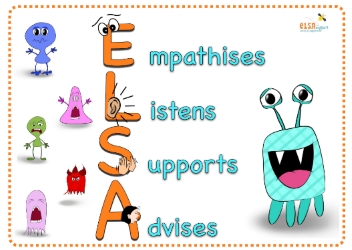 An ELSA is a specialist assistant with a wealth of experience of working with children. ELSAs are trained and regularly supervised by the Educational Psychologists in your Local Education Authority. An ELSA is a warm and caring person who wants to help your child feel happy in school and reach their potential educationally. Their aim is to remove the barriers to learning and to have happy children in school and at home. ELSAs can help with loss and bereavement, self-esteem, social skills, emotions, friendship issues, relationships, anger management, behaviour, anxiety, bullying, conflict and relaxation techniques.